
 KO
KO
 EN
EN
 JA
JA
 TW
TW




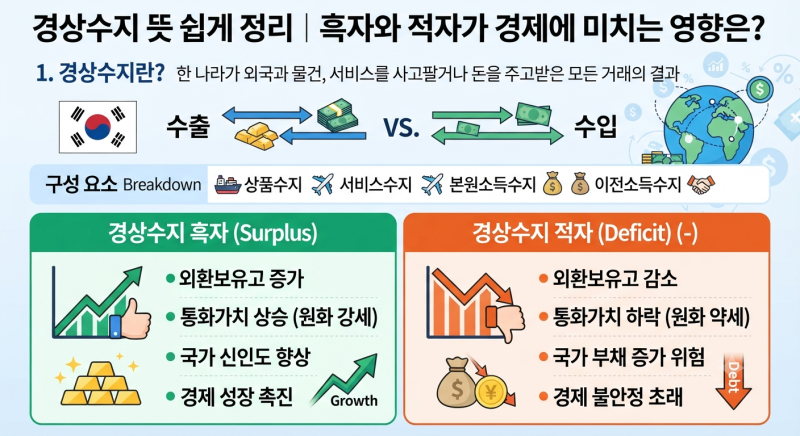
The current account and trade balance are crucial economic indicators frequently discussed in Korean economic news, reflecting a nation's international transaction performance. While the trade balance primarily focuses on the import and export of goods, the current account offers a broader perspective by encompassing goods, services, primary income, and secondary income, providing a comprehensive view of the nation's overall financial health. Due to differences in scope and reporting timelines, it is possible for the trade balance to show a deficit while the current account registers a surplus for the same period.
The trade balance is calculated by subtracting goods imports from goods exports, reflecting only tangible product transactions like semiconductors and automobiles. This figure is typically released early each month by the Korea Customs Service and the Ministry of Trade, Industry and Energy, serving as a vital economic barometer for export-dependent countries like Korea. In contrast, the current account is a more inclusive indicator, incorporating not only the balance of goods but also services (e.g., travel, transportation), primary income (e.g., interest, dividends from overseas investments), and secondary income (e.g., remittances). The Bank of Korea typically releases current account data about a month later, offering a wider lens on international transactions.
Bloggers highlight that a trade deficit does not necessarily imply a current account deficit, often citing factors like substantial overseas investment income or service surpluses. For instance, even with a deficit in the services balance due to increased overseas travel, a large inflow of dividends from foreign investments can sustain a current account surplus. It is also emphasized that a current account surplus does not automatically lead to a stronger Korean Won. Increased overseas asset investments by domestic investors can boost demand for the dollar, potentially causing the Won-Dollar exchange rate to rise, as various factors like US interest rates and dollar value collectively influence exchange rates.




![[39] Current Account and Capital Account: A Complete Guide to Export-Driven Nations' True Foreign Exchange Earning Power](https://mblogthumb-phinf.pstatic.net/MjAyNjA3MTRfOTYg/MDAxNzgzOTY5MDk3NjUz.dVa_kPlaznF4-nAwUv6S6MsZHMrJPLk2ml4vnT_p91Mg.90oUSWuZhHq9872P2UUyk7sbyIz1IXzjh2c1kkVceVsg.PNG/image.png?type=w800)